

Mxene Functionalized 3D Printing Electrochemical Capacitor electrode
I. Overview of the article.
3D printing is a manufacturing technology that can be used to produce electrochemical capacitors with custom shapes and reduce material waste. However, at present, the range of commercial carbon additive filament is limited, which leads to poor capacitance performance of 3D printing electrode because of its high thermoplastic content. In this paper, a new method to improve the electrochemical performance of 3D printing electrode is proposed, which is based on the electrochemical activation of the electrode and the functionalization of MXene. The prototype MXene Ti3C2 is used to modify the surface of the 3D print electrode; it has been shown to increase the capacitance of the electrode almost three times. These findings provide a new way to improve the performance of 3D printing electrochemical capacitors and pave the way for the further development of other electrochemical applications.
II. guided reading of picture and text.
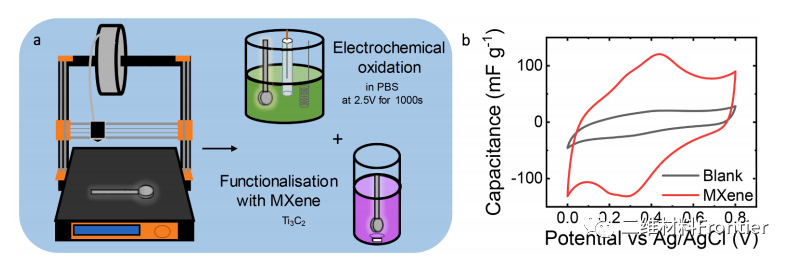
Figure 1. Preparation of Ti3C2@3DnCE. (a) it is explained that the 3D printed carbon electrode was prepared by FFF and subsequently modified by electrochemical activation and MXene functionalization. (B) the capacitance enhancement of Ti3C2@3DnCE in 2m H2SO4.
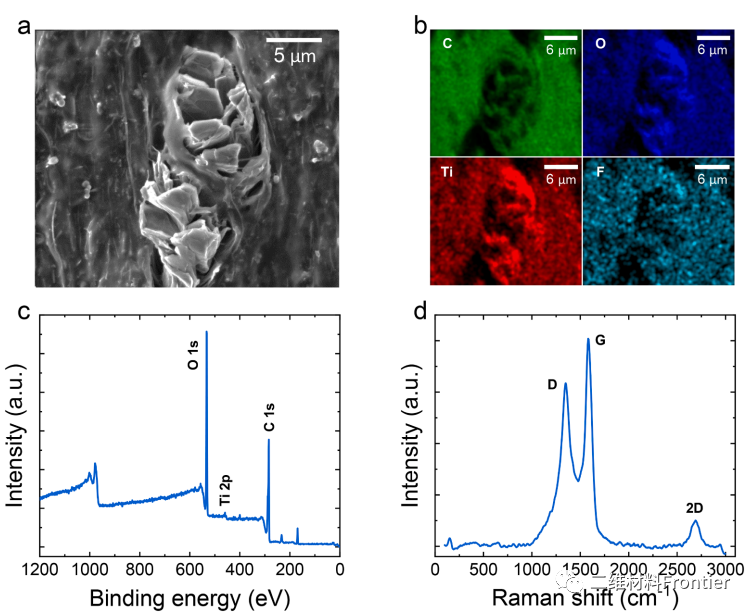
Figure 2. (a) SEM image of Ti3C2@3DnCE and (b) EDS analysis, showing the modification of 3DnCE by Ti3C2. (C) the XPS of Ti3C2@3DnCE, indicating the presence of Ti 2p. (d) the Raman spectra of Ti3C2@3DnCE are mainly nano-ribbons.
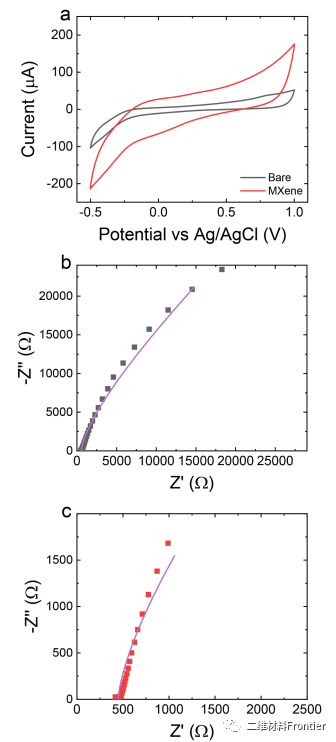
Figure 3. Electrochemical activity of Ti3C2@3DnCE in [Fe (CN) 6] 4 / 3 ≡ in 0.1m KCl electrolyte. (a) CV; (b) 3DnCE at 25 mV s 1 for Ti3C2@3DnCE and (c) EIS from 100 kHz to 100 mHz at 0.2V for Ti3C2@3DnCE.
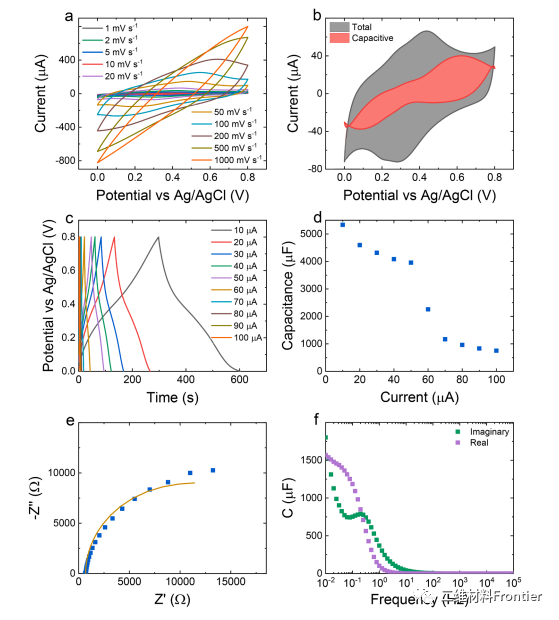
Figure 4. Electrochemical characteristics of electrochemical capacitor Ti3C2@3DnCE in 2m H2SO4 three-electrode cell. (a) Analysis of capacitive current contribution of cv and (b) Ti3C2@3DnCE at different scanning rates.(C) constant current charge-discharge cycle at different currents and (d) derived rate capability. (e) Nyquist diagram showing the derived Bode diagram of measurement data (represented by points) and fitting data (continuous lines) and (f) Ti3C2@3DnCE.
III. Summary of the full text.
In this work, the surface of 3D printed nano-carbon electrode was modified with Ti3C2.This is achieved by electrochemical activation of 3DnCE materials and subsequent functionalization of Ti3C2. Ti3C2@3DnCEs was characterized by SEM, EDS, XPS and Raman spectra, and the composition and material structure of the product were determined. Ti3C2@3DnCEs was then tested as an electrochemical capacitor and found that it had better capacitance than bare 3DnCEs. This is due to the ability of MXene materials to conduct diffusion-controlled redox processes and surface capacitance processes. MXene materials improve the interconnection of graphene and bring about improvements. Therefore, it is possible to obtain advanced 3D printing electrochemical capacitors through MXene functionalization.This work opens up a new opportunity for the functionalization of 3DnCE in electrochemical applications.
This information is from the Internet for academic exchange only. if there is any infringement, please contact us to delete it immediately.
18915694570
Previous: Gold nanoclusters with